Creative Commons License

Unless otherwise noted all original material on this website is licensed under a Creative Commons license.

Thoughts, reflections, news, and musings from a veteran Silicon Valley journalist and commentator.

May 01, 2008

My New Project Launches: ReelChanges.org

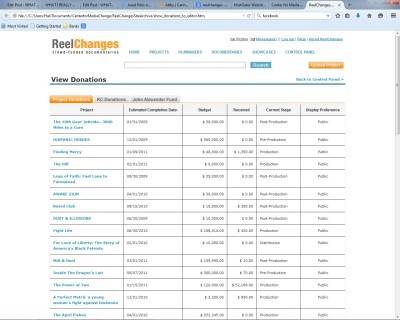
We launched ReelChanges.org today.

I could not be more excited or more proud.

It's the project I've been dropping hints about in this space for months. Given the trailblazing nature of our venture, I never knew exactly how much I should say or write about what we were doing before we were actually ready to do it. My big fear, of course, was that someone else or some other group would get a jump start on us in organizing the community of users whose participation is critical to our early success.

But thanks to a high-profile launch at today's well-attended conference and blog posts by two of those present (here and here) ReelChanges site registrations are already taking off. In fact, we could not be off to a better start. I feel like ten thousand pounds have been lifted off my shoulders. I may even start returning social phone calls again soon.

The demo was well-attended. I could almost see the wheels turning in some of their heads as they were stimulated by what they saw and by what ReelChanges could mean for them and for journalism.

It was also an incredible relief to finally be able to "show our work" after so many months.

So, what have we created?

A unique new online non-profit-based business model that we believe has the power to help preserve and positively transform the business and practice of journalism by modernizing the profession for the digital interconnected age.

On a technical level, our basic goal, what I originally set out to do, was to figure out how we could use the exact same web-based, digital technologies that are destroying the old business model that financed the creation of high-quality journalism to construct a new business model capable of taking its place. So that is what our ReelChanges team has done. Version 1.00 anyway. And in the process, we also discovered something quite remarkable. We could get the job done, in fact the very best way to get the job done, would involve substantially reducing and redefining the role of traditional media industry gatekeepers such as publishers, network owners and advertisers. Put simply, what ReelChanges enables is shifting more of the power in the journalism industry where it rightfully belongs: into the hands of those who produce the journalism.

Several people deserve special thanks. ReelChanges board member Andy Hertzfeld continues to generously provide critical advice and leadership in the development of our user interface. Filmmaker Yoav Potash has helped guide our efforts from day one. My close friend Dick Alexander's support has been instrumental. And, of course, there is the entire dev team affiliated with the always remarkable Texity , Inc. in Pune, India, Chicago and Canada led by Swati Jalnapurkar, as well as the rest of our board and all our other volunteers and supporters, all of whom we'll eventually find a way to honor on the site. We have an incredibly diverse, talented and hard-working team that is full of creative, dedicated whip smart people who put in long, 12 and 15 hour days when needed. You know who you are. I could not be more deeply proud of every one of you or more grateful. The best things users find when they visit ReelChanges.org came from this wonderful team.

Two other heartfelt notes of thanks.

The first, to Tom Murphy, the founder and editor of Redwood Age, who graciously jumped to my assistance when my laptop lost its connection to the Internet right before my demo. Tom quickly installed the flash player needed for the demo and lent me his computer for the demo. I am not sure what I would have done without him. He also has a great, smartly targeted website and the same general focus and philosophy as mine, that quality always wins in the end.

And finally, a grateful word to a remarkably kind and generous new friend, J.D. Lasica. J.D. wrote one of the first blog posts about my demo. He has also been a key supporter of ReelChanges since the moment he first heard about our project. He even offered to provide free hosting services for us through his groundbreaking and highly-respected Ourmedia.org. J.D. is also one of the forces behind Bid4Vid, an innovative new venture with many of the same goals as ReelChanges, including helping create jobs for journalists and filmmakers, although with a different strategy. It was wonderful to meet J.D. in person at the demo. He's someone I have admired for a long time and, if you just look over his site, is clearly a lot more than just brilliant.

So please, help us spread the word: ReelChanges.org is open for business. Let's see if we can change the world one film at a time.

April 14, 2008

Jokerman by Bob Dylan

Jokerman by Bob Dylan is one of my favorite songs of all time. A good friend just passed along this wonderful version:

What an incredible talent. We won't see his likes again.

March 24, 2008

Google's "White Space" FCC Proposal Heralds New Day for Telecom and Broadcasting

I hope today's news today that Google has written a formal letter to the Federal Communications Commissions requesting permission to use so-called "white space" spectrum on an unregulated basis is the first shot in a long overdue legal fight to free our nation's airways from unnecessary, counterproductive over-regulation that primarily benefits a handful of enormously powerful, well-connected media and telecommunications corporations.

As I explained in a column some years ago, the federal government's current spectrum allocation policies, which were established decades ago, have long since become technologically obsolete and completely unnecessary for the purposes that were originally intended and that were narrowly permitted under the Constitution, namely, to prevent signal interference that would otherwise have made commercial broadcasting impossible. That was true at one time. But it has not been true for many years, perhaps decades now. If Google puts up its dukes and really fights this fight it is hard to see how the U.S. Supreme Court will have any rational choice other than to throw out the fed's current rule-making authority in the spectrum allocation business in favor of requiring the FCC to enact regulations that permit spread spectrum or spectrum sensing technologies that enable anyone to use the airwaves without hurting anyone else and, most importantly, without government permission. In the end, it's a free speech issue. If the federal government does not have to restrict the use of the airwaves to enable broadcasting then why on earth should it do so?

Up til now, the big money has all been behind allowing the federal government to allocate spectrum that just a few huge companies can then control. Google and its high-tech allies, including, in this case, Microsoft, have the financial resources to prevail against against the big telcos and media companies in the federal courts and, if needed, in Congress. So kudos to Google for taking the first step in what could be a long but very worthwhile legal battle. If Google pushes the spread spectrum/spectrum sharing issue in the courts the only way they and the American public can lose is if the U.S. Supreme Court agrees to shred constitutional protections for free speech and freedom of the press.

March 22, 2008

Eeeek! I lost everyone's email address!

Eeeek! Followed by ugh...

I just realized that my email address book was one of the items not saved after my hard drive crash on Thursday. I was able to resurrect about a dozen addresses from memory, but the rest, 15 years worth maybe, are gone. Lost little electrons on a now inoperable encrypted hard drive. What a strange feeling. Anyway, if you are a friend or contact, even if you have recently been in touch with me via email, please do me a favor and send me an email asap, empty is fine, so I can add you back to my address book. It's a drag, but considering the stuff I did save, it could have been much worse. I know many of you check in here from time to time, so please do help me keep in touch.

March 21, 2008

Hewlett Packard is Back: Stock Price to Follow?

I went shopping yesterday at Fry's and online to replace my less than 2-year old Sony Vaio desktop PC after its very large and very unreliable hard drive went fully belly up, clunk, scrape, blue screen of death and all (yes, I was reasonably fully backed up, whew, and warning to the wise: these things do happen, although it is the first time it ever happened to me...)

Anyway, I was blown away, really quite impressed, and totally surprised to end up buying a Hewlett Packard PC, my first ever HP-PC. If my experience is common, I suspect it means HP will continue to gain market share.

I've owned pretty much every brand of PC, starting with an IBM, then one called Leading Edge, a Compaq, some clones, and at least two Sony's, one of which was a pretty decent machine. But I never bought an HP which, for a variety of reasons, always seemed like an uncompelling alternative. In fact, back in 2001 I even panned the inept way HP merchandised their products.

This time around, I checked out all the usual suspects, DELL, Gateway, even ACER, both online and at the store. In both venues one thing was clear: HP's more diverse and versatile product line stood head and shoulders above the competition. I haven't paid much attention to this beat since around 2000-1 when I covered it pretty extensively for CNBC.com. But it seems pretty clear to me that in the time that has passed HP has leapfrogged the field.

I was dazzled by the choices and price points available at Fry's. HP had a computer for every niche. And when I visited HP's website it was much more user-friendly, intuitive and helpful than either Dell, Gateway or Acer's. Flat out, the HP site did a much better job of quickly matching my needs with the right product at a great price. When I got stuck at one point I pushed a "call me" button on the site and about a minute later my phone rang with an HP salesperson on the other end, smart, who was able to rapidly guide me through the rest of the transaction. Even better, she already had my partial order in front of her when she called so closing the deal was a breeze.

As I say, I don't cover tech stocks these days. And I have not looked all that closely at the company's detailed financials other than noticing what looks like a pretty reasonable current and forward P/E. But, for what it's worth, after I bought my new HP computer, I bought some of the company's stock, too. HP is definitely back.

March 18, 2008

Memo to Blogosphere: Let's Drop the Term Mainstream Media -- "MSM" -- and Instead Use Corporate-Owned News Media -- "CONM"

I've been wanting to suggest this for quite some time, so here goes.

Memo to bloggers everywhere, on both the Left and the Right:

Please, let's all drop the misleading and unhelpful acronym "MSM" from our shared vocabularies as bloggers and use the term "Corporate-Owned News Media" or "CONM" (pronounced "CON-UM") instead.

Here's why:

The term "mainstream media" carries a connotation that the views expressed within are part of some mainstream. I understand the history of the term. That it was meant to describe what "most" members of a particular professional group were doing. But as a term "MSM" has outlived its usefulness and is, in the context of current events, misleading and far too generous.

Rhetorically speaking, if the MSM represents some part of the "mainstream," then that would put its critics, again, rhetorically speaking, somewhere in the fringes, I would suppose.

But, in our cacophonous diversity, we bloggers are the mainstream.

And what we object to, in growing numbers, are media, the news media in particular, that pollutes the vital public information streams on which our democracy depends, or manipulates the electoral process with propagandistic Big Lie techniques that lead to the sort of ineffective, counterproductive social policies that have brought our great nation low. The term Corporate-Owned News Media, "CONM," is a far more apt descriptor of this increasingly apparent underlying socio-political-economic malignancy.

What's more, the term "CONM" also far more accurately focuses attention on the underlying source of the most problematic issues currently attributed to the MSM, including by more explicitly identifying the at least reasonable suspicion that hidden corporate agendas can play a role in advancing the public disinformation campaigns we so frequently see.

For these reasons and more henceforth I'm going to stop using the term "MSM" and instead use "CONM," with a short explanation the first time I use it in each post. I hope others will consider doing so as well.

Sample use:

After watching the CONM continue to repetitively rebroadcast excerpts of the speeches of Rev. Jeremiah Wright today, over, and over and over again, in an obvious effort to smear Senator Obama by association, calling FOX and CNN and the rest of their ilk part of the American "mainstream" is a kindness I can no longer stomach. Their corporate agendas are showing. The least we can do is call them on it.

Not This Time: Obama on Guilt by Association

From Senator Obama's speech today, "Toward a More Perfect Union":

"We can play Reverend Wright's sermons on every channel, every day and talk about them from now until the election, and make the only question in this campaign whether or not the American people think that I somehow believe or sympathize with his most offensive words. We can pounce on some gaffe by a Hillary supporter as evidence that she's playing the race card, or we can speculate on whether white men will all flock to John McCain in the general election regardless of his policies. We can do that.


But if we do, I can tell you that in the next election, we'll be talking about some other distraction. And then another one. And then another one. And nothing will change. That is one option.

Or, at this moment, in this election, we can come together and say, "Not this time."

This time we want to talk about the crumbling schools that are stealing the future of black children and white children and Asian children and Hispanic children and Native American children. This time we want to reject the cynicism that tells us that these kids can't learn; that those kids who don't look like us are somebody else's problem. The children of America are not those kids, they are our kids, and we will not let them fall behind in a 21st century economy. Not this time.

This time we want to talk about how the lines in the Emergency Room are filled with whites and blacks and Hispanics who do not have health care; who don't have the power on their own to overcome the special interests in Washington, but who can take them on if we do it together.

This time we want to talk about the shuttered mills that once provided a decent life for men and women of every race, and the homes for sale that once belonged to Americans from every religion, every region, every walk of life. This time we want to talk about the fact that the real problem is not that someone who doesn't look like you might take your job; it's that the corporation you work for will ship it overseas for nothing more than a profit.

This time we want to talk about the men and women of every color and creed who serve together, and fight together, and bleed together under the same proud flag. We want to talk about how to bring them home from a war that never should've been authorized and never should've been waged, and we want to talk about how we'll show our patriotism by caring for them, and their families, and giving them the benefits they have earned.

I would not be running for President if I didn't believe with all my heart that this is what the vast majority of Americans want for this country. This union may never be perfect, but generation after generation has shown that it can always be perfected. And today, whenever I find myself feeling doubtful or cynical about this possibility, what gives me the most hope is the next generation - the young people whose attitudes and beliefs and openness to change have already made history in this election."

March 15, 2008

Must Obama Answer for Rezko, Power and Rev. Jeremiah Wright?

Is anyone else getting just a little bit sick of the corporate news media's relentless guilt by association smears on Senator Barack Obama? After months of pummeling him with charges that did not stick, his critics have evidently decided one way to cut him down to size is to continually link him with other people he knows who have screwed up in some way.

It's the cheapest trick in the book.

I don't know about you. But I know I am not terribly interested in what someone who knows Obama has said or done unless Obama himself is involved in some direct way.

An off-the-record comment made by an unpaid foreign policy adviser?

A former contributor who may be a real estate hustler?

Controversial passages from sermons made by his local charismatic minister?

If there was a real story in any of these items it would have been to surface the comments that were made or actions taken, determine if Obama agreed or participated, and if he didn't to then file the story in the "no-story" circular file. That is what a responsible journalist would do. Instead, we get a barrage of "when did he stop beating his wife?" stories that continue to run long after the relevant exonerating information is known. These repetitive stories accomplish nothing, other than tarring Obama in the most unfair fashion, by associating him with comments or actions for which he bears absolutely no direct personal responsibility.

To be fair, Senator Clinton should also not be held responsible for stupid comments made by her supporters, such as the recent dust-up over comments made by former vice presidential nominee Geraldine Ferraro. In some cases, stories like these are just byproducts of the old journalistic "gotcha" formula. In other cases they are pretty obvious plants, part of an attempt to kill with a thousand cuts. But either way, editors would be wise to think about whether they're really worth the ink. Some better ideas for stories: asking the candidates about say, a foreign policy, or an economic policy, maybe?

Over the last few days, Obama has been typically patient in answering questions about these associations. But at some point in time I hope he, or someone, stands up and points out, with the appropriate traces of indignity, just how ugly and un-American guilt by association really is. Journalists who participate in it are reckless and irresponsible. Asserting guilt by association is just plain sleazy.

Weintraub Cites Kenworthy's Work on Income-Inequality

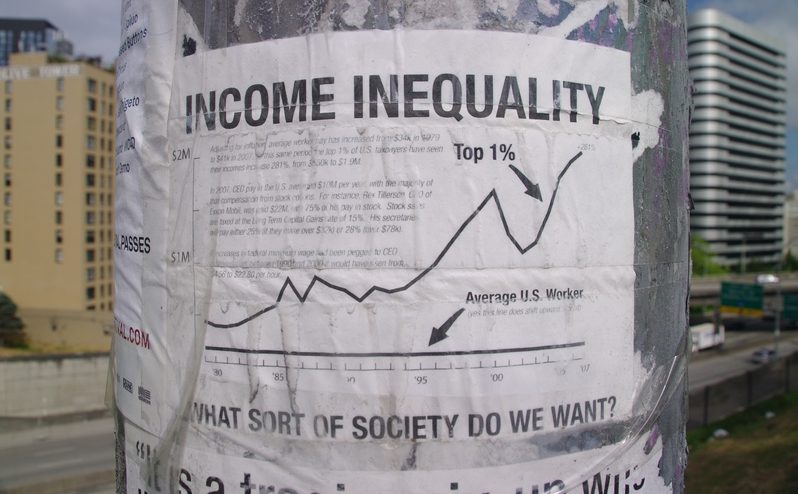
My cousin, sociologist Jeff Weintraub, just forwarded a highly informative post, must reading, excerpting the work of his friend, Lane Kenworthy. Both deserve praise for bringing scholarly attention to a topic that often gets ignored or denied here in Silicon Valley. Perhaps some facts will help. Couldn't hurt. Here are some excerpts of Weintraub's excerpts of Kenworthy's highly useful post:

Lane Kenworthy (Consider the Evidence) March 9, 2008 The Best Inequality Graph


Income inequality in the United States has been rising since the 1970s. What is the most effective way to succinctly convey this fact?

Here is my choice (a pdf version is available here)

bestinequalitygraph-figure1-version3.png

The chart shows average inflation-adjusted incomes of the poorest 20%, middle 60%, and top 1% of households since the 1970s. The incomes include government transfers and subtract taxes. For the bulk of American households, incomes have increased moderately or minimally. For those at the top, by contrast, they have soared.

Read the Rest

distributionofthepie-figure1-test1.png

From 1947 to 1973 [i.e., the quarter-century after WWII that looks to many people, in retrospect, like a "golden age" of continuous economic growth, increasingly pervasive affluence, and decreasing income inequality in all western societies--JW], incomes at each of these three levels grew at an annual rate of about 2.7%. That was approximately the same as - actually slightly faster than - the rate of growth of the economy as a whole; GDP per capita during that period grew at a rate of 2.5% per year.

Since 1973 incomes in the middle and lower portion of the distribution have increased much less rapidly: 0.8% per year at the 60th percentile, 0.5% per year at the 40th, and just 0.3% per year at the 20th. Is this because the economy as a whole has failed to grow? No. The annual growth rate of per capita GDP since 1973 has been 1.9%. Instead, it's because most of that economic growth has gone to those at the top of the distribution.

The dashed lines in the chart show what incomes at the 60th, 40th, and 20th percentiles would have looked like had they grown at the same 1.9%-per-year pace as the economy since 1973. The difference is striking. Incomes for a very large swath of the American population would be much higher - $15,000 to $30,000 higher - if economic growth since the mid-1970s had been distributed more equally.

One local fable shattered by these data is the prevalent myth that stock options did a lot to close the income gap over the last few decades. More recently, we're even hearing worried claims from area CEOs and even members of our local congressional delegation (Democrats!) that our middle class will suffer the most, and in very great numbers, if the recent long overdue federal reform mandating stock option expensing by corporations is not repealed. Reviewing the data, though, it looks like it must have been a pretty thin slice of the middle class that scooped up all those stock options despite some pretty misleading and self-serving claims.

March 13, 2008

Gaining Traction in the Blogosphere

I just learned that Blogged.com has named my humble little outpost in the blogosphere the 10th best blog focused on higher education policy issues. Poking around, I also found out I am 12th on their list of best blogs with content related to the Democratic Party and, by the skin of my teeth, also on their list of the country's top 100 political blogs. Naturally, I'm flattered.

The news comes just a few weeks after this blog was picked up by the Blogburst syndicate, which is yielding upwards of 2000 headline impressions a day in affiliated publications such as Reuters and the Chicago Sun Times. Originally, this whole blogging thing started out for me as just an outlet for thoughts and ideas I could not publish elsewhere. But lately, more and more it's beginning to feel like an engine that's starting to turn over. The timing of all this is very welcome, though, particularly given the announcement about a revolutionary new non-profit media-related venture that I plan to make in this space in just a few days. More on that shortly.